Performance day in Batticaloa

Hetty Blades

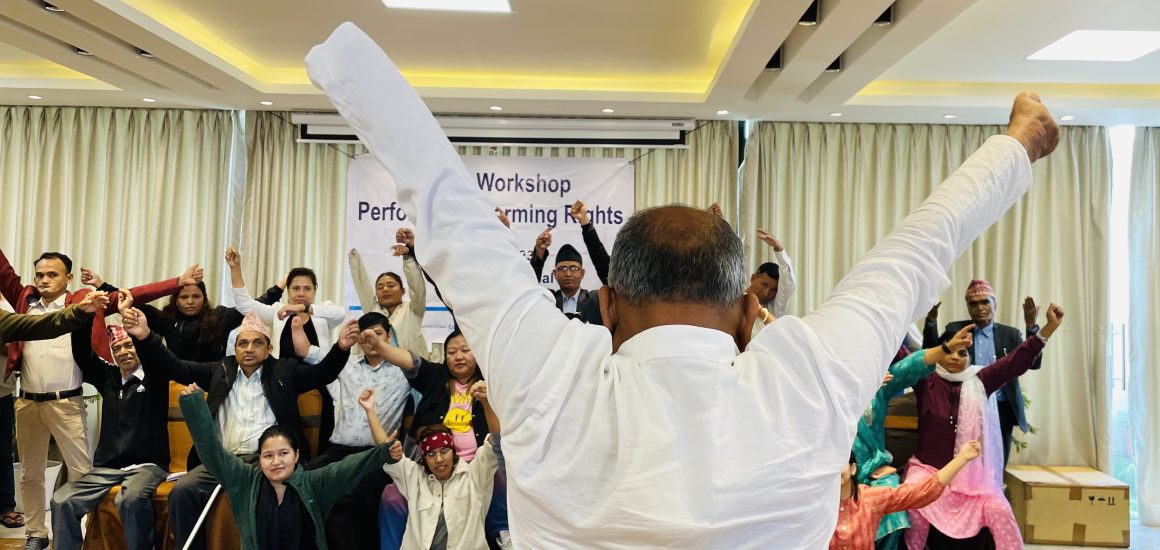
Sunday was the last day of the workshops in Batticaloa. The participants performed at Kallady beach in the afternoon, before heading out to Chenkalady, a nearby village. We all boarded a bus that had been hired to transport all the participants between performances. Spirits were high, with many people dancing and singing in the aisles!

When we arrived at the beach there were not many people around so in order to gather people, students from the Swamy Vipulananda Institute formed a congo line and danced off down the beach. It seemed to do the trick, as the crowds soon gathered.

The performance was brilliant! All the participants’ hard work paid off. As we gathered feedback from the audience, one man told me that it had completely changed his opinion of what disabled people are capable of.

After a few false starts in Chenkalady (they couldn’t perform at the intended site due to a funeral), the second performance took place in a market in Vantharumoolai. As the sun went down, a large crowd gathered. Here the audience included two government ministers. who gave speeches about the importance of the work and handed over the VisAbility certificates to the participants.

Having witnessed how hard everyone has worked, and how much some people have grown in confidence over the course of the week, I was really moved by the performances. Some of the participants were also emotional, and told me how happy they were. At the end of this first week, it is clear to me that this work enables many of the participants to have positive and uplifting experiences. Most seemed to be leaving the workshop feeling more confident and happier than when they arrived.

During the interviews that we conducted before and after the rights workshops, it was clear that some disabled participants had not been fully aware of the benefits and services they are entitled to. Others who were aware and had applied  were still waiting for government decisions. Many participants reported that they now know more about their rights and feel braver about fighting for them. The challenge now is to maintain these feelings of strength and confidence and channel them into ensuring they are provided with the benefits and services they are entitled to. I am looking forward to returning to Batticaloa in December, and hope that I am met with news of positive change from the people that I said goodbye to last night.

Below are links to two articles about the performances from local newspapers which include images of the shows and award ceremony.

Batti News: http://www.battinews.com/2017/07/blog-post_4.html?m=1

Battinaatham: http://battinaatham.com/description.php?art=10945

Translation and adaptation

Hetty Blades

We are coming towards the end of the first week of fieldwork in Batticaloa. It’s been full of anticipation, excitement, and exchange. VisAbility have been working with a large group (there were more than 40 participants to start with) from Batticaloa and the surrounding area. The group comprises disabled and non-disabled participants, and includes a number of dance and drama students from the Swami Vipulananda Institute of Aesthetic Studies (Eastern University), where the workshop is being held.

The workshops last for seven days, and participants work from 9am – 4pm. There are six days of movement workshops and a one-day rights workshop, which took place on Wednesday. The week will culminate in two public performances on Sunday. Energy is high, despite the intense schedule!

This is a multi-lingual project. The participants speak Tamil, the VisAbility team speak Sinhalese, German and English. This multiplicity gives rise to various acts of translation and interpretation within the studio. Although the VisAbility team use an interpreter, he is not always needed, as the actions of the team often transmit the ideas and instructions through demonstration and gesture, without the need for spoken word. Participants translate these instructions in their own bodies, and inform each other through movement, mime and speech when people don’t understand.

In Lars’s post on 19 June, he quoted Mahesh describing dance as a universal language. In dance, we are used to thinking about the expressive potential of the body, and its capacity to communicate. I have often thought about this rhetoric in quite an abstract way, however, watching these workshops makes me understand Mahesh’s words differently. It is not only the potential of dance to express abstractly that is important here, but the way that the body can directly communicate instruction and ideas without codified systems, that is so central to being able to work together without relying solely on the spoken word.

Furthermore, many of the exercises that the group are working with involve copying. Gerda and Mahesh encourage close and accurate attention to the nature of each other’s movement. One the one hand, direct copying is encouraged, meaning that people attempt to inhabit the physicality of another. Yet, on the other hand, this inhabitation inevitably involves an action of translation and adaptation into their own bodies. Observing these multiple layers of direction, translation, adaptation and interpretation it is really interesting to see how instructions, ideas and movement vocabularies transmit and transform actions across language barriers and in different physicalities.

Nothing Has Happened

Lars Waldorf (Batticaloa)

During the Q&A session after our disability rights panel, several audience members and panelists complained about government inaction. One disability advocate said he had “called the Minister to do something but nothing has happened.” Another said “the government has not fulfilled any of their promises but at least they have signed the [disability rights] treaty.” Sadly, it seems to be a government of equal opportunity when it comes to unrealized promises – as International Crisis Group describes in its dispiriting, new report: “Sri Lanka’s Transition to Nowhere.”

A reporter at our panel also questioned whether disability advocacy is having any effect. One advocate then responded: “When people with disabilities make claims, it makes a big difference.” Indeed, people with disabilities and their advocates have been claiming more loudly and more insistently since Sri Lanka ratified the UN Convention on the Rights of Persons with Disabilities (CRPD) in 2016.

One example is a new coalition calling itself the “February 8 Movement” after the date of CRPD ratification. That coalition is pushing for an independent Disability Rights Commission and a high-level government coordination mechanism to replace the National Council for Persons with Disabilities that it views as largely captured by the Ministry of Social Empowerment and Welfare. The coalition argues that the National Council and Ministry will be ineffectual when it comes to protecting and promoting disability rights given their adherence to a charitable approach to disability.

Another example is how disability advocates successfully lobbied the Public Representations Committee on Constitutional Reforms to recommend the full inclusion of disability rights (including socio-economic rights and affirmative action) into any new constitution. The Public Representations Committee’s final report also highlighted the importance of access to justice for people with disabilities – a key component for their legal empowerment. Unfortunately, the prospects for meaningful constitutional reform are increasingly bleak.

Given the domestic deadlocks, Sri Lankan disability advocates are increasingly taking their fight to the UN in Geneva. The International Centre on Ethnic Studies (which, despite its name, is doing important research on disability) submitted a shadow report to the UN Committee on the Elimination of Discrimination against Women in January. The Disability Organizations Joint Front submitted a shadow report to the UN Committee on Economic, Social and Cultural Rights in April. Still, international advocacy is hampered by the government’s refusal to ratify the CRPD’s Optional Protocol that allows the CRPD Committee in Geneva to hear complaints against Sri Lanka.

Of course, the big issue is whether treaty ratification, domestic lobbying, and international advocacy are making any real difference to the lives of ordinary Sri Lankans with disabilities. That remains to be seen. But I couldn’t help noticing that some of the train seats formerly reserved for clergy are now reserved for people with disabilities. That may not be much but it is perhaps the start of something.

IMG_3455[1]

Linking Intangible Cultural Heritage and Disability Rights

Lars Waldorf (Batticaloa)

It’s hard to say no when a project collaborator asks a favor. That’s how I found myself doing a panel for a conference on “intangible cultural heritage” organized by the Swamy Vipulananda Institute of Aesthetic Studies (Eastern University) in Batticaloa.

I’ve always been a bit suspicious of the term “cultural heritage” – it reminds me too much of that classic line from Jean-Luc Godard’s Contempt: “Whenever I hear the word ‘culture,’ I bring out my checkbook.” Of course, that’s a sly inversion of the infamous Nazi sentiment: “Whenever I hear the word ‘culture,’ I reach for my gun.” Indeed, “cultural heritage” is all too often something to be fought over or to be commodified – especially in a place like Sri Lanka.

Preparing the panel forced me to consider how “cultural heritage” might (and might not) be re-purposed to promote peacebuilding and sustainable development. Arguably, transitional justice and post-war development have focused too much on tangible cultural heritage – memorials and museums – and not enough on intangible cultural heritage – the performing and performative arts. The latter might (possibly) be less susceptible to state capture, exclusivity, and “monumentalism.” In part, then, this research project looks at whether dance might (in the words of UN Special Rapporteur Pablo de Greiff) “provide space for victims to … try out new identities, including the identity of a rights claimant” and whether those new identities can be sustained.

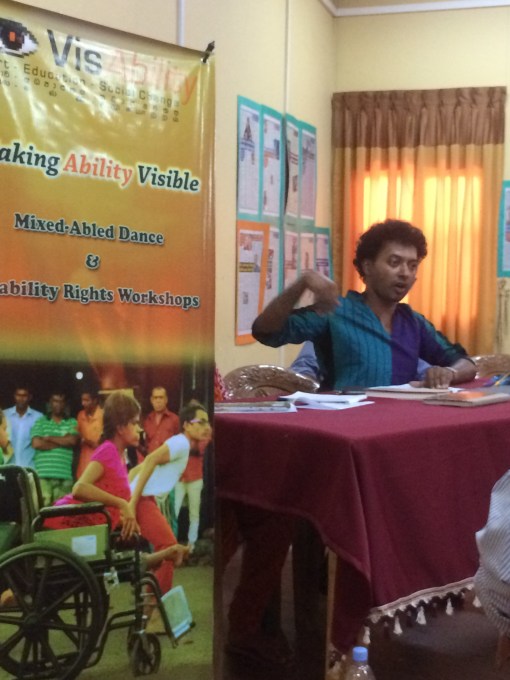
The panel brought together artists (with VisAbility and Kathiravan), disability advocates (with CAMID and Handicap International), and researchers (with VisAbility and the Swamy Institute) from various linguistic/cultural backgrounds: American, German, Sinhalese, and Tamil. Mahesh Umagiliya described his personal journey from traditional Kandyan dance at the Chithrasena School to mixed-abled dance with DIN A 13 tanzcompany to choreographing mixed-abled street performances with VisAbility. He concluded by saying:

Dance for me is a universal language. If we all can engage with dance with our mind, body, and soul, we don’t need any other language to understand each other. And this is the moment where the dialogue and healing starts.


IMG_0574 (2)

Mahesh Umagiliya at Intangible Cultural Heritage conference (VisAbility e.V.)

Celebrating World Autism Day in Colombo

April 2, 2017

Lars Waldorf

I spent part of Sunday watching some 30 young people with varied disabilities perform a head-spinning variety of dance styles – from break-dancing to Bollywood to conga line – in celebration of World Autism Day. Within the space of an hour, they had gone from what I think was a Kataragama Kawadi dance to what I know was an American cheerleader routine (complete with pom-poms!). In so doing, the concert certainly delivered on its promise to “celebrate diversity.”

This EASE Foundation concert was a happy and homespun affair geared entirely to the children and their families. I was something of a gate-crasher but was warmly welcomed by EASE’s co-founders, Anoja and her son Chandima. Their work is really inspiring and they tell their own story better than I ever could: http://easesrilanka.org/about-us/e-a-s-e-story/.

Unfortunately, our research project in Sri Lanka will only be working with people with physical difficulties. Our project partner, VisAbility, wanted us to work with people with learning disabilities but, unfortunately, the research team was not able to get ethics approval for that. My university was (understandably) concerned that I did not have the skills set or experience to be able to determine when people with learning disabilities were giving informed consent. While I share their concern, I can’t help worrying that the end result may be not enough attention to people with mental disabilities.

Meeting the Advisory Group

Hetty Blades

Tuesday (17 January 2017) was an exciting day for the project team as we gathered physically and virtually for our first Advisory Group (AG) meeting. Lars, Helena, and I were joined by AG member, Sarah Whatley, while Gerda, Mahesh, Adam, and AG members Darshan Ambalavanar, and Kanchana Nilmini Liyanapathiranage joined via Skype from Sri Lanka and Devon. There was merry chaos as we juggled four Skype connections across three computers from a small and very warm room in Coventry.

During the meeting, the team introduced the aims of the project and discussed VisAbility’s previous work, before turning our attention to methods, dissemination, and sustainability. The question of how to capture, record, and analyse the experiences of the participants is central to this project. We are planning to work with a range of people, including workshop participants and their family members, friends and relatives as well as people working in local NGOs and government. We will use a mixed-method approach, including interviews, discussion, questionnaires, and movement tasks in order to examine and analyse the impact of VisAbility’s work on the participants’ self-esteem, empowerment, and physical and mental wellbeing.

The AG raised some important questions about the project. For example, when talking about methods an important point was made about the cultural inscription of the body. The way we move and the signification of gesture and body language differs across cultural contexts. Equally, the methods for analysing these things are culturally specific, calling for an innovative cross-cultural approach. The considerations of inter-cultural research came up in multiple ways throughout the meeting with discussions about the necessity and complexities of translation, and questions about how the language used to describe disability might differ between the UK and Sri Lanka.

Some of the participants have become disabled as a result of the war or illness, whereas others have disabilities that they were born with. Therefore, another important question raised by the AG was about how the project will cater for people with a wide range of disabilities. Furthermore, we were probed about how we will make sure that the project will benefit participants in both the short and long term. It is very important to the team that this research supports the people and communities we are working with, and this meeting was really useful for helping us to clarify how we will go about ensuring this.

Despite some inevitable connection problems it was wonderful to meet some of the AG, and to have an opportunity to probe some of our thinking about the project. Thank you to everyone who was involved! I am looking forward to the next meeting!