Hetty Blades
As indicated in the title of the project, the aim of this research is to ascertain the degree to which combining dance and human rights education ‘empowers’ participants, in particular people with disabilities in Sri Lanka, many of whom are living in poverty. Although legal experts might disagree with me, legal empowerment appears to have a fairly clearly delineated meaning to my novice eyes. For example, the UN General Assembly report on Legal Empowerment of the Poor and Eradication of Poverty (2009) describes it as “the process of systematic change through which the poor are protected and enabled to use the law to advance their rights and interests as citizens and economic actors” (2). However, in the arts, the term is used in a more fluid way. The breadth of the concept is something addressed in-depth by dance scholar Sara Houston in her article ‘Participation in Community Dance: A Road to Empowerment and Transformation?’ (2005). She points out how empowerment can have different meanings in different contexts, and points out some practitioners’ concerns that the potential of the arts to lead to transformation and empowerment can sometimes be expressed in simplistic terms (167).
Whilst legal empowerment is central to the aims of VisAbility’s work, it is not the only way that they seek to empower participants. In a recent interview, co-founder and choreographer Gerda König pointed out how empowerment can mean much more than someone exercising their legal rights, suggesting that participants facing challenges in their lives and overcoming insecurities after involvement in the workshops are markers of increased empowerment.
It is therefore important for us to have a clear sense of what we mean by empowerment in order to be able to measure it. In order to clarify the way that we are thinking about empowerment, we asked some of our interviewees what the term meant to them. Of course, there are obvious problems with the task of translating a term that has no set meaning. Nevertheless, the responses were interesting. A number of participants talked about empowerment as being taught things or being given confidence — implying that it is external and can be learned. On the one hand, VisAbility’s dance and rights workshops clearly aim to empower through legal education and dance experiences. However, on the other hand, this also suggests that participants are buying into ‘top-down’ notions of empowerment, in which those in positions of (em)power(ment) can teach others how to gain this quality.
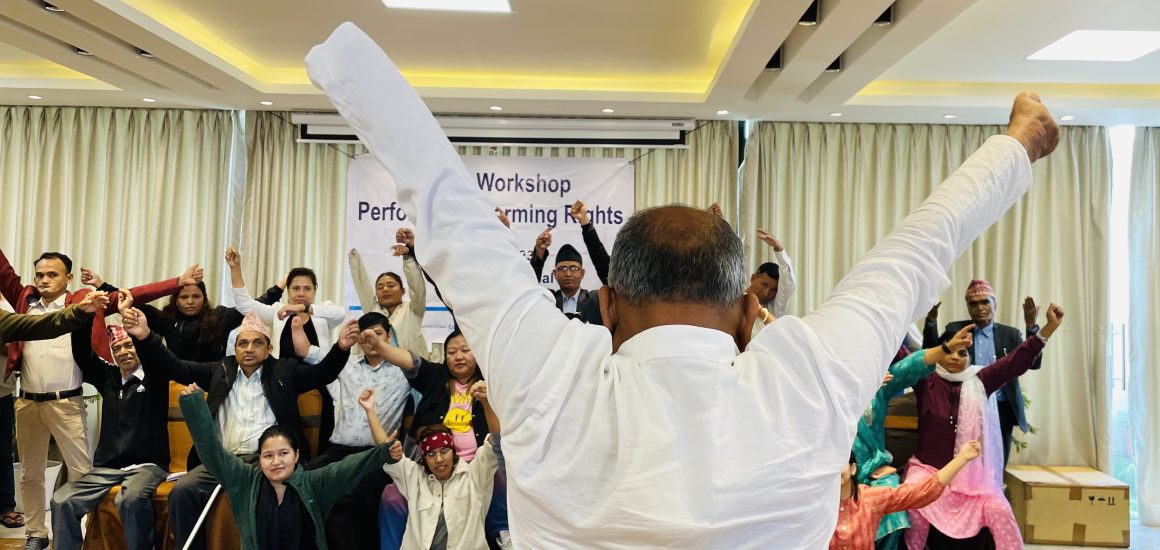
Reflecting on the first round of fieldwork, the title of the project has taken on a deeper meaning. Each workshop resulted in a performance. These were major milestones for the participants, many of who were very shy at the beginning of the week and hesitant to perform in public. Our interviews revealed that the performances enabled participants to locate and demonstrate new feelings of confidence. The association of empowerment with a performative act implies something fleeting and temporary, but also repeatable. As we look to the next round of fieldwork in December, I am interested in thinking more about how various forms of empowerment might manifest as performative acts in the daily lives of the participants, and how we can reach a co-constructed understanding of what it means for them to experience and inhabit empowerment.
References
Houston, S. (2005) ‘Participation in Community Dance: A road to empowerment and transformation?’. New Theatre Quarterly, 21(2), pp.166-177. http://epubs.surrey.ac.uk/1659/1/fulltext.pdf
UN General Assembly (2009) Report on Legal Empowerment of the Poor and Eradication of Povertyhttp://www.un.org/esa/socdev/documents/reports/Legal%20empowerment%20of%20the%20poor.pdf
 Performing/Informing Rights