Hetty Blades
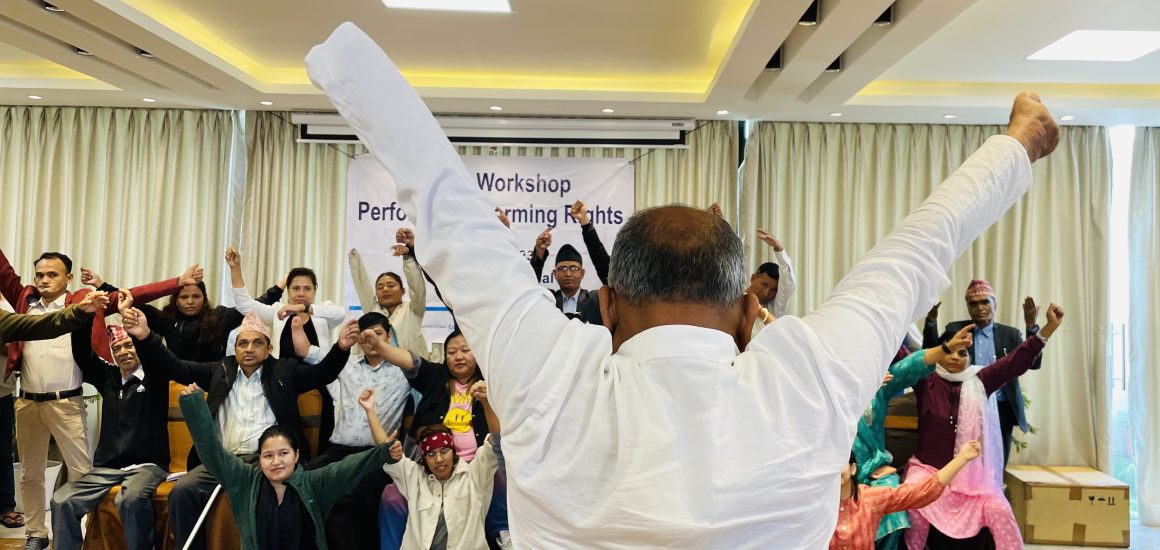
We are coming towards the end of the first week of fieldwork in Batticaloa. It’s been full of anticipation, excitement, and exchange. VisAbility have been working with a large group (there were more than 40 participants to start with) from Batticaloa and the surrounding area. The group comprises disabled and non-disabled participants, and includes a number of dance and drama students from the Swami Vipulananda Institute of Aesthetic Studies (Eastern University), where the workshop is being held.
The workshops last for seven days, and participants work from 9am – 4pm. There are six days of movement workshops and a one-day rights workshop, which took place on Wednesday. The week will culminate in two public performances on Sunday. Energy is high, despite the intense schedule!
This is a multi-lingual project. The participants speak Tamil, the VisAbility team speak Sinhalese, German and English. This multiplicity gives rise to various acts of translation and interpretation within the studio. Although the VisAbility team use an interpreter, he is not always needed, as the actions of the team often transmit the ideas and instructions through demonstration and gesture, without the need for spoken word. Participants translate these instructions in their own bodies, and inform each other through movement, mime and speech when people don’t understand.
In Lars’s post on 19 June, he quoted Mahesh describing dance as a universal language. In dance, we are used to thinking about the expressive potential of the body, and its capacity to communicate. I have often thought about this rhetoric in quite an abstract way, however, watching these workshops makes me understand Mahesh’s words differently. It is not only the potential of dance to express abstractly that is important here, but the way that the body can directly communicate instruction and ideas without codified systems, that is so central to being able to work together without relying solely on the spoken word.
Furthermore, many of the exercises that the group are working with involve copying. Gerda and Mahesh encourage close and accurate attention to the nature of each other’s movement. One the one hand, direct copying is encouraged, meaning that people attempt to inhabit the physicality of another. Yet, on the other hand, this inhabitation inevitably involves an action of translation and adaptation into their own bodies. Observing these multiple layers of direction, translation, adaptation and interpretation it is really interesting to see how instructions, ideas and movement vocabularies transmit and transform actions across language barriers and in different physicalities.
 Performing/Informing Rights