
Lars Waldorf (Batticaloa)
It’s hard to say no when a project collaborator asks a favor. That’s how I found myself doing a panel for a conference on “intangible cultural heritage” organized by the Swamy Vipulananda Institute of Aesthetic Studies (Eastern University) in Batticaloa.
I’ve always been a bit suspicious of the term “cultural heritage” – it reminds me too much of that classic line from Jean-Luc Godard’s Contempt: “Whenever I hear the word ‘culture,’ I bring out my checkbook.” Of course, that’s a sly inversion of the infamous Nazi sentiment: “Whenever I hear the word ‘culture,’ I reach for my gun.” Indeed, “cultural heritage” is all too often something to be fought over or to be commodified – especially in a place like Sri Lanka.
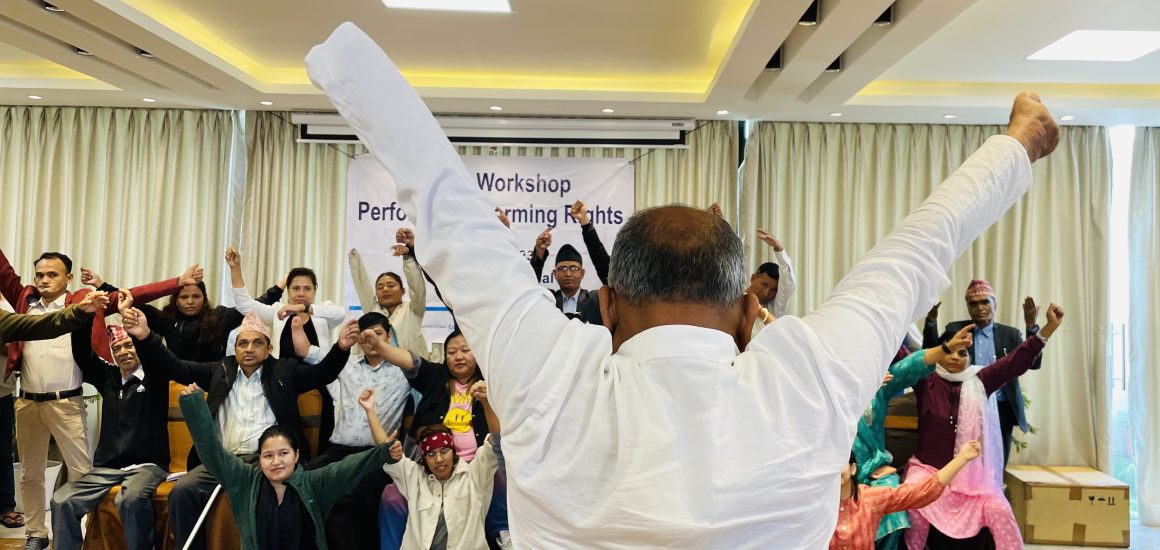
Preparing the panel forced me to consider how “cultural heritage” might (and might not) be re-purposed to promote peacebuilding and sustainable development. Arguably, transitional justice and post-war development have focused too much on tangible cultural heritage – memorials and museums – and not enough on intangible cultural heritage – the performing and performative arts. The latter might (possibly) be less susceptible to state capture, exclusivity, and “monumentalism.” In part, then, this research project looks at whether dance might (in the words of UN Special Rapporteur Pablo de Greiff) “provide space for victims to … try out new identities, including the identity of a rights claimant” and whether those new identities can be sustained.
The panel brought together artists (with VisAbility and Kathiravan), disability advocates (with CAMID and Handicap International), and researchers (with VisAbility and the Swamy Institute) from various linguistic/cultural backgrounds: American, German, Sinhalese, and Tamil. Mahesh Umagiliya described his personal journey from traditional Kandyan dance at the Chithrasena School to mixed-abled dance with DIN A 13 tanzcompany to choreographing mixed-abled street performances with VisAbility. He concluded by saying:
Dance for me is a universal language. If we all can engage with dance with our mind, body, and soul, we don’t need any other language to understand each other. And this is the moment where the dialogue and healing starts.
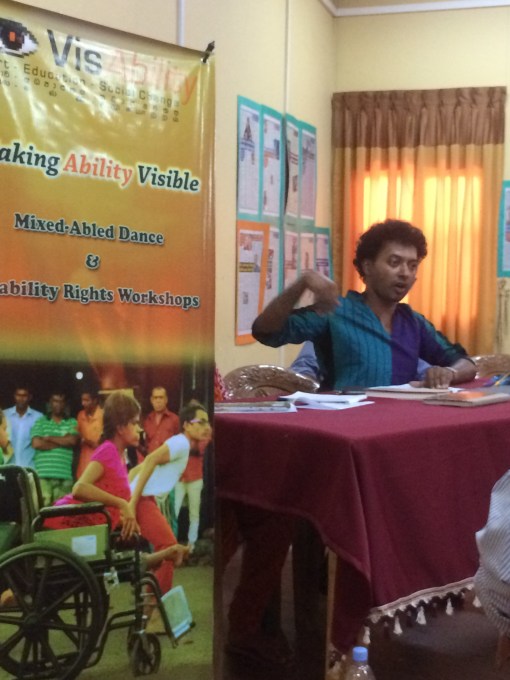
Mahesh Umagiliya at Intangible Cultural Heritage conference (VisAbility e.V.)
 Performing/Informing Rights